The hands that complement the intelligence.
Development, Operation and Sourcing are not three departments handing work along. They map onto one gate sequence and overlap across it.
THE GATE SEQUENCE
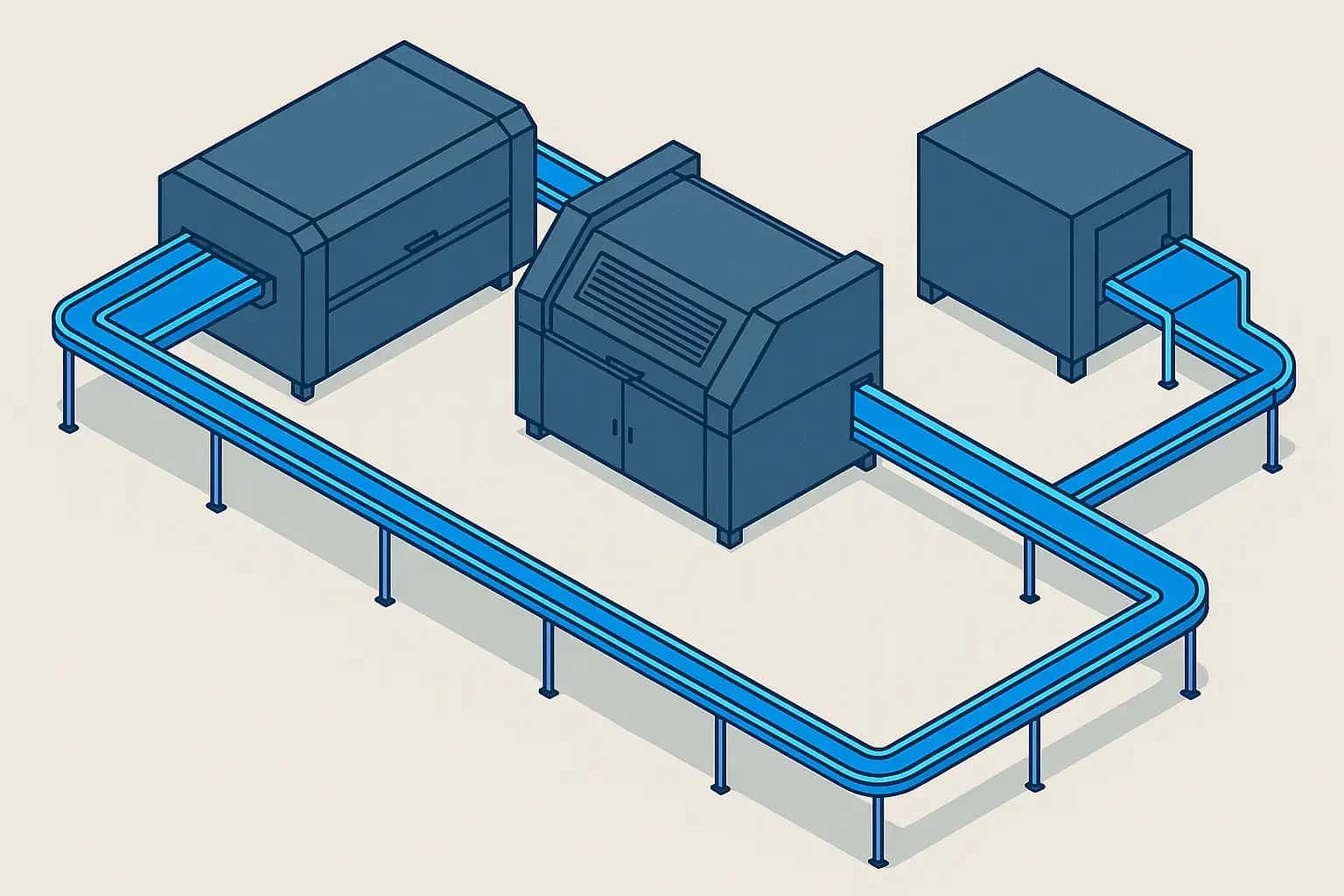
Eight gates from concept to mass production. The families below sit across them rather than after one another.
GATE 01
Concept
Development
GATE 02
Schematic & ECAD
Development
GATE 03
PCBA
Sourcing
GATE 04
Firmware
Development
GATE 05
Verification & validation
Development
GATE 06
Regulatory certification
Development
GATE 07
NPI
Operation
GATE 08
Mass production
Operation
SERVICE FAMILIES
Development
From selection to a design that has been verified rather than assumed.
- MCU/SoC solution selection
- Chosen against the duty cycle and the software that has to run on it, not against a datasheet headline.
- Schematic and ECAD layout
- Layout treated as an electrical decision, because at these speeds it is one.
- Verification and validation testing
- Evidence produced during development, which is the only point it can be produced honestly.
- Aesthetic design and CMF
- Colour, material and finish decided with the tooling, not applied to it afterwards.
- Conceptualisation to detailed design
- One team carrying the intent from the first sketch to the released pack.
- Backend software and apps
- The services and interfaces the device needs, built as part of the product.
- Regulatory compliance
- The applicable regime decided at concept, when it is still cheap to design for.
- Early feasibility studies
- An attempt to kill the idea cheaply, before it costs a programme.
Operation
Getting it built, and keeping it built to the same standard.
- New product introduction (NPI)
- The transfer from a design that works to a line that repeats it.
- Contract-manufacturing management
- Managing the factory relationship as an engineering interface, not a purchase order.
- Quality assurance and source inspection
- Inspection at the supplier, before the parts ship rather than after they arrive.
- Supply-chain management
- Continuity planned for, including the part that goes end-of-life mid-programme.
- Sustaining quality
- The discipline that keeps unit ten thousand identical to unit one.
Sourcing
Parts, and the consequences of choosing them.
- Electronic component procurement
- Sourced against availability and lifecycle, not only against price.
- Component localisation
- Finding the equivalent that is actually equivalent, and proving it.
- Quick-turn PCB/PCBA
- Prototype boards fast, through the same quality gates volume will use.
- PCB/PCBA EMS management
- Managing the assembly partner to a specification rather than to a quote.
- Mechanical parts
- Tooling, moulding and finishing, with the tolerance stack understood.
- Mechatronic equipment and components
- Where the electrical and mechanical designs have to agree.
STANDARDS & INTERFACES
The interfaces and regimes this work actually touches. A standard that the record does not evidence does not appear here.
| Standard or interface | Applies to |
|---|---|
| OCPPcharge point to back end | charging |
| Medical-device controlsdesign controls and evidence | validation |
| EMCelectromagnetic compatibility | CE · FCC · UKCA |
| Product safetymarket-dependent regime | CE · UL · CCC |
| Energy efficiencyUS EPA programme | Energy Star |
Standards and interfaces reference
- OCPPcharge point to back end
- charging
- Medical-device controlsdesign controls and evidence
- validation
- EMCelectromagnetic compatibility
- CE · FCC · UKCA
- Product safetymarket-dependent regime
- CE · UL · CCC
- Energy efficiencyUS EPA programme
- Energy Star