
Intelligence is engineered in, not bolted on.
One architecture, three layers, one closed loop. What follows is the specification, layer by layer, in the order a signal passes through it.
THE ARCHITECTUREENGINE-01
- Physical edge
- Rugged sensors and edge processors that survive heat, dust and vibration.
- Intelligence core
- A real-time AI + RTOS layer making zero-latency decisions at the edge.
- Digital cloud
- Scalable analytics and model training that feed evolved models back to the edge.
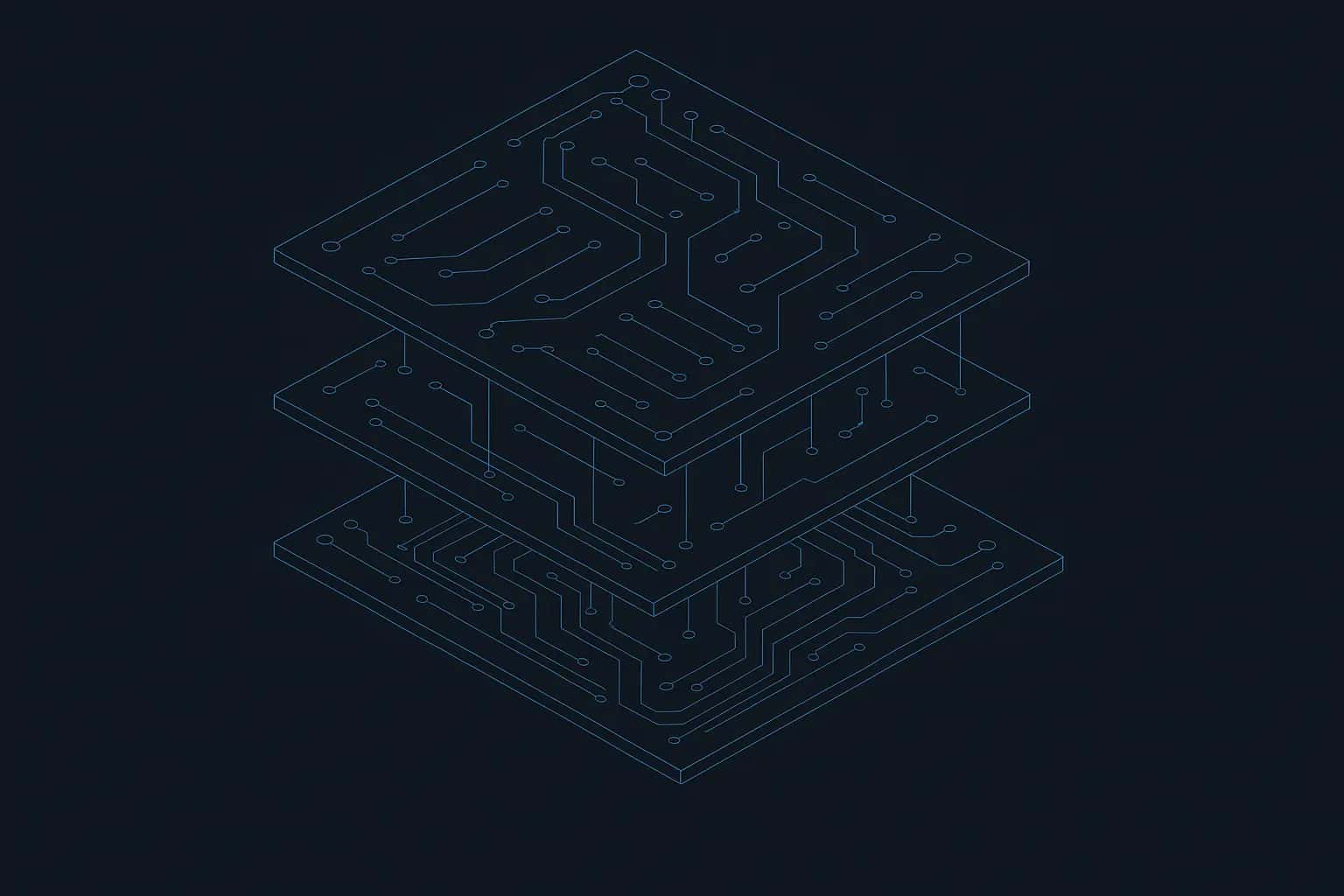
Three stacked layers. A physical edge of rugged sensors and edge processors; an intelligence core running real-time AI and an RTOS; and a digital cloud for analytics and model training. Data rises from the edge to the cloud, and trained models return to the edge, closing the loop.
- Layer 1 of 3: Physical edge. Rugged sensors and edge processors that survive heat, dust and vibration.
- Sensor array — Environment heat, dust, vibration
- Power stage
- Edge processor — Role acquisition and control
- I/O
- Actuator
- Layer 2 of 3: Intelligence core. A real-time AI + RTOS layer making zero-latency decisions at the edge.
- RTOS — Scheduling deterministic
- Inference — Decision point at the edge
- Control loop
- Layer 3 of 3: Digital cloud. Scalable analytics and model training that feed evolved models back to the edge.
- Analytics
- Model training — Output evolved models to the edge
- Fleet management
Connections:
- Sensor array delivers measurements to Edge processor.
- Edge processor issues actuation commands to I/O.
- Power stage delivers drive current to Actuator.
- Edge processor passes data up to RTOS.
- RTOS schedules Inference.
- Inference supplies setpoints to Control loop.
- Inference passes data up to Analytics.
- Analytics supplies datasets to Model training.
- Control loop passes data up to Fleet management.
- Model training returns trained models to Inference.
- Fleet management returns updated operating policy to Control loop.
- LAYER 01 · Hardware foundation
- LAYER 02 · Intelligence core
- LAYER 03 · Digital cloud
LAYER 01
Hardware foundation
Rugged sensors and edge processors that survive heat, dust and vibration.
The foundation is specified by its environment, not by its feature list. A sensor that is accurate in a laboratory and drifts at temperature has not been engineered; it has been selected.
Environmental specification is therefore a design input, decided at concept alongside the electronics. Derating decided late is a redesign, not a tuning step.
| Thermal | heat |
|---|---|
| Particulate | dust |
| Mechanical | vibration |
Hardware foundation — engineering properties
- Thermal
- heat
- Particulate
- dust
- Mechanical
- vibration
LAYER 02
Intelligence core
A real-time AI + RTOS layer making zero-latency decisions at the edge.
Inference runs on the device because a decision that waits for a network is not a real-time decision. The round trip to a cloud is not slow because the cloud is slow; it is slow because it is a round trip, and its worst case is set by a network nobody controls.
Determinism is the second half of the argument. An RTOS schedules work against a known worst case rather than a good average, so the system's behaviour under load is a number that can be designed around instead of a hope. In a mission-critical setting that distinction is the whole product: an average is a marketing figure, a worst case is an engineering commitment.
Putting intelligence here rather than in the cloud is therefore not a deployment preference. It is what makes the response time a property of the device instead of a property of the connection.
| Decision point | on device |
|---|---|
| Scheduling | deterministic |
| Dependency on link | none |
Intelligence core — engineering properties
- Decision point
- on device
- Scheduling
- deterministic
- Dependency on link
- none
LAYER 03
Digital cloud
Scalable analytics and model training that feed evolved models back to the edge.
The cloud layer does the work the edge cannot: aggregate across a fleet, train against more data than one device will ever see, and hold the history that makes a trend visible.
What makes this an ecosystem rather than a product is the return path. Trained models go back down to the edge, so the device that generated the data is improved by it. The loop closes — and a closed loop is the difference between a system that reports and a system that learns.
| Aggregation | fleet-wide |
|---|---|
| Return path | models to edge |
| Loop | closed |
Digital cloud — engineering properties
- Aggregation
- fleet-wide
- Return path
- models to edge
- Loop
- closed
THE ARC
- 01From automation to autonomy.
- 02Decentralised intelligence.
- 03The context-aware machine.
DEEPER READ
Layer interfaces, data paths and deployment topology.
For an architect who wants the level below this one: how the layers interface, where data actually travels, and how the engine meets systems that already exist. It is denser than this page on purpose.
IN DEVELOPMENT · 2026
What is being built this year.
These are in development and none of them has shipped. Nothing here appears in the delivered record on Proof, and it should not be read as capability already demonstrated.
- AI agent controllersIoT & embeddedController hardware with the agent running on the device.
- Energized Traveler SuitcaseIoT & embedded
- EV charger backend and applicationNew energy & EVServer-side platform and the companion app.
Your System. Our Intelligence.
The engine is not a product you buy. It is the architecture TrustXP builds into the system you need.
REV 2026.1