
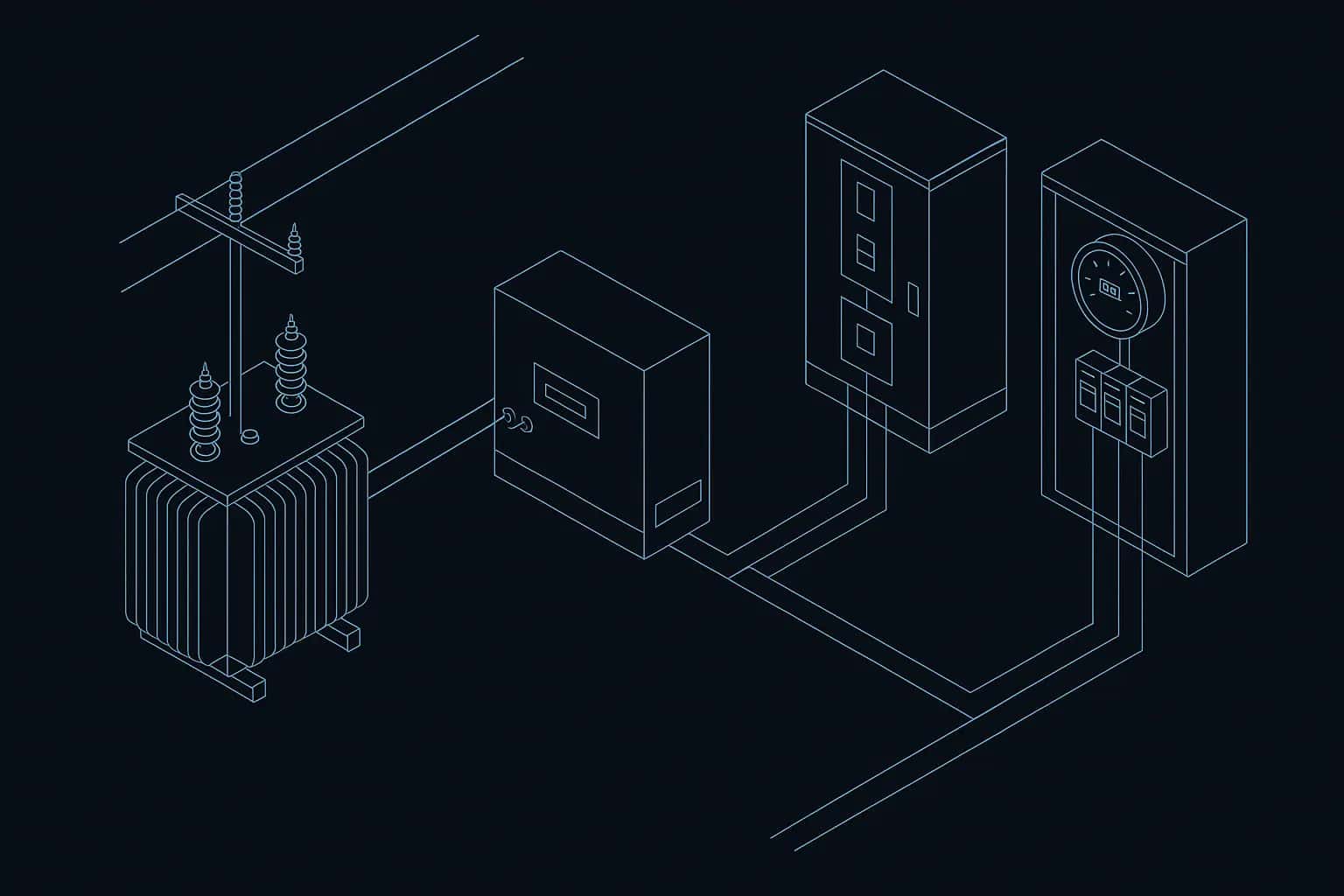
Grid stability is an engineering constraint, not a service level.
Charging and storage systems answer to the grid they connect to. That connection sets the design, not the other way around.
WHAT THE WORK TURNS ON
- Grid stability
- What the system does to the connection it sits on, at the moment of peak demand.
- Load optimisation
- Distributing available power across a site rather than sizing every point for its maximum.
- Predictive maintenance
- Telemetry gathered because it will be used, not because it can be collected.
ARCHITECTURE
The architecture this sector draws on. It is the same system TrustXP builds in the corresponding domain — the sector changes what matters in it, not what it is.
EV charging system architecture
- Power path
- Grid connection through conversion to the vehicle connector.
- Control and telemetry
- Charge control and the reporting link to cloud services.
Grid connection feeds power conversion, which feeds the charge controller and the connector. Energy storage and solar sit on a parallel path into the same conversion stage, and a telemetry link reports to the cloud layer.
- Layer 1 of 2: Power path. Grid connection through conversion to the vehicle connector.
- Grid connection — Concern grid integration
- Power conversion — Concern high-voltage power electronics
- Energy storage — Concern thermal design and derating
- Solar input
- Connector — Standard safety standards
- Layer 2 of 2: Control and telemetry. Charge control and the reporting link to cloud services.
- Charge controller — Interface OCPP
- Telemetry
Connections:
- Grid connection supplies grid power to Power conversion.
- Power conversion delivers DC output to Connector.
- Energy storage discharges into Power conversion.
- Solar input charges Energy storage.
- Power conversion passes data up to Charge controller.
- Charge controller passes data up to Telemetry.
- Charge controller returns firmware and setpoints to Connector.